www.slideshare.net/kurtnelson/fun-motivational-sayings-and-visuals
[slideshare id=3011220&doc=funmotivationalsayingsandvisuals-100128013141-phpapp02]

www.slideshare.net/kurtnelson/fun-motivational-sayings-and-visuals
[slideshare id=3011220&doc=funmotivationalsayingsandvisuals-100128013141-phpapp02]
 I just read a blog post by Michael Lee Stallard entitled “Should Leaders Care About Employee Happiness?” in which he talks about how happiness is important to business and how organizations need both “task” and “relationship” excellence. What struck me hard however, were two simple sentences he wrote:
“We are human beings, not machines. Emotion matters, even in business.”
How very, very true. “Emotion matters, even in business.”
This should be a no brainer. We shouldn’t even need to bring this up and yet we do need to bring it up because leaders often forget this. We lead like our employees are parts of a big organizational machine and if we just push and pull the right levers, we will get the desired output. We build systems looking for optimal performance and use incentives as if they were the gasoline that runs our engines.
We forget that “we are human beings, not machines.” And as Dan Ariely points out, we are “irrational” human beings.
We need to stop thinking about business as a machine, and think about it more as a volunteer service club. Imagine you are the president of a Rotary Club and you need to get your club members to work on a project. You don’t offer them an incentive. You don’t command that they give up their Saturday to build a music park in North East Minneapolis or spend two years working to build a high school in Haiti (FYI – our Rotary Club did both of these – see here). You don’t give them new computerized systems that churn out delivery plans. You can’t. Service clubs don’t work that way…
What you do is you appeal to their “humanness” and their “emotion.”
Yes, if you want to be an effective leader, you definitely need to focus on the very human side of things. Remember “We are human beings, not machines. Emotions matter, even in business.”
Would love your human thoughts on this – click on “leave a comment” below
We’d like to know what you think was the best incentive program that you’ve ever been a part of – either as a participant, a designer, consultant or manager.
Leave a comment and let us know…just click below  on “leave a comment”
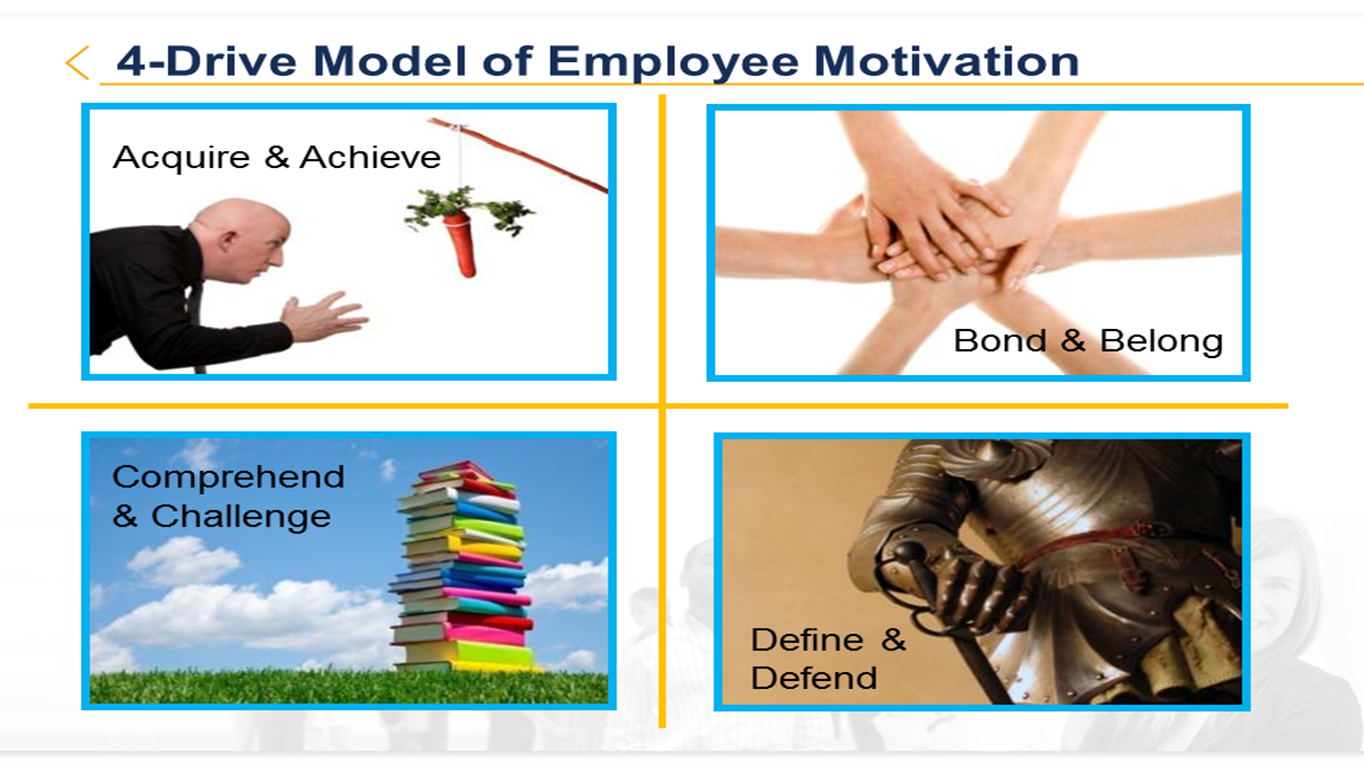 In order to maximize motivation leaders need to provide an opportunity for employees to satisfy the four drives: Acquire & Achieve, to Bond & Belong, to be Challenged & Comprehend, and to Define & Defend. Leader’s can begin to influence and start to fulfill each of these drives by using some of the systems and processes they already have in place. Alterations and enhancements to those systems and processes can help the organization be one in which employees can satisfy their drives and become highly motivated!
We attempt to map the connection between each of the four drives and the different organizational systems/processes that impact them.
Drive A: Achieve & Acquire
This drive is primarily satisfied through a company’s Reward System. This drive is met when companies have a total reward system that: highly differentiates top performers from average performers and average performers from poor performers; clearly ties rewards to performance; recognition is given for outstanding performance; pay is above competitive benchmarks in the city/industry; and top employees are promoted from within.
Drive B: Bond & Belong
This drive is mostly met through an Organizations Culture. Organizations who’s culture is one that: embraces teamwork; encourages the development of friendships and bonding; one in which employees can depend on their peers to help them; a culture that values collaboration; a culture that celebrates and shares; and a culture that is focused on the “employee first” are crucial to this drive being met.
Drive C: Challenge & Comprehend
This drive is fulfilled primarily through Job and Organizational Structure. Organizations need to ensure that the various job roles within the company provide employees with stimulation that challenges them or allows them to grow. Job roles that satisfy this drive should: be seen as important in the organization; jobs should provide personal meaning and fulfillment; roles should engender a feeling of contribution to the organization; organizational structures that provide growth opportunities within the company; learning offerings (training, seminars, etc) that provide employees with new skills and knowledge, job sharing/rotational opportunities that can provide new challenges are the key to fulfilling this particular drive.
Drive D: Define & Defend
This drive is met mostly through an employee feeling alignment and connection to the organization. This can be done through a company’s Vision/Reputation and their Performance Management System. Organizations that have a strong vision or positive reputation in the marketplace can help create that alignment with employees. The company should be perceived to be: fair; providing a valued service or good; ethical; and good stewards. Organization’ performance management systems can also help through giving insight into the company’s vision. Performance management system should be one that is: open and transparent; perceived to be fair; provides direction; and that is trusted by employees.
What great leaders need to do:
Rightfully or not, many employees look to the company to provide them their motivation for work. While many of these motivations are inherently in a company, good leaders know that they have to work at it constantly to ensure that they are satisfying all four drives.
1. Focus on all 4 Drives:
It is important to understand that all the good work that a company or leader does in these four areas can be ruined if one of the four drives is lacking. Research shows that weakness on fulfilling one of the 4-Drives “castes a negative halo” on how the company or leader performs on all the other 3 drives. It is important then for a leader to ensure that they are identifying and addressing any issues that they see in any of the four drive areas.
2. Individualize motivation:
It is also important to know that individual employees each have a unique 4-Drive Motivational profile. In other words, some employees will respond or require greater satisfaction of the A drive, while others will focus in on the C drive (or B or D). Each employee will perceive how the company or leader is performing on these differently. Good leaders are one’s who understand those differences and can focus specific employees on the satisfiers of their specific needs.
3. Communicate effectively:
Leaders need to be able to effectively communicate how their systems, policies and structure align with the four drives. In other words, they need to be able to explain to map out the connections between what the company is doing or providing and how that would satisfy one or more of the drives. For instance, a leader could discuss the reason that they are sponsoring a community service event is not only to help the community (drive D) but also to provide an opportunity for employees to get to know each other and their families (drive B) and to give them a chance to learn a new skill (drive C).
4. Experiment:
Good leaders need to constantly look for ways of enhancing each of the four drives. This is an ongoing commitment that requires leaders to be focused on looking for different ways in which they can provide the opportunities for employees to satisfy their needs. They should implement new structures and processes and see how they work.
Next steps:
We can help you or your company use the 4-drives to increase motivation. We offer assessment, consulting and workshops on this. You can contact us at 612-396-6392 or kurt@lanterngroup.com
Let us know what you think – leave a comment below!
The 4-Drive Model of Employee Motivation as we’ve discussed (here and here) provides a very robust theory that when applied, can help companies increase the motivation of their employees. One of the key tenants of the Four Drive Theory is that each individual is motivated by all four drives (A: Acquire & Achieve, B: Bond & Belong, C: Challenge & Comprehend, and D: Define & Defend) but that each individual’s motivational profile will be different (i.e., one employee might be driven more by drives A & C compared to another employee who is more motivated by B & D or B & C).
The important thing to understand here is that everyone’s motivation is different!
Which can be a problem since most companies don’t customize their incentive plans down to the individual. Often an organization’s customization comes down to offering a few additional spurts throughout the year. So unless the company hires only people with a specific motivational profile, some employees will not be as motivated as they could be.
Oh the motivation of a Saturday morning when I was a kid…need I say more?

Saturday Morning Motivation
 Wouldn’t it be great if we all woke up with this type of enthusiasm everyday!

RU Motivated?
Ok, here is some fun stuff you can get and impress your friends!
Do you need a t-shirt to keep you or your team smiling and maybe even a little motivated? How about a coffee mug that gets you going each morning? Check out these:
You can order these and many more at http://www.cafepress.com/ru_motivated
For every t-shirt bough in the next 10 days, $1.00 will be donated to Japanese Tsunami relief!
Enjoy!
You can order these and many more at http://www.cafepress.com/ru_motivated


Over the last few years I’ve used 3×5 index cards to jot down things that I need to do more often. These were often written in response to a particular need I felt I had or a specific situation. Some where just thoughts that I had to try to make my life a little better. It started simple with a note to “Go outside and play with the dog.” It expanded to 32 ideas that have helped me stay grounded. Here is what the two cards look like (notice they are stapled together – I should have used a larger index card):

Whats important to me
I have this posted on my bulletin board in front of me everyday. I don’t always do these…but I often do. It helps ground me and keep me motivated. It helps me escape the trap of working all the time. I hope that it helps keep me balanced. I thought you might enjoy.
1. Go outside and play with the dog
2. Take a five minute stretch break
3. Focus on the BIG stuff
4. Drink tea
5. Write thank you’s
6. Call old friends [We never seem to do this enough]
7. Eliminate the trivial
8. Clean up after yourself [this was in response to my overly messy desk]
9. Appreciate the moment
10. Get involved
11. Surprise someone by doing something nice
12. Take a walk
13. Notice the little things
14. Cook a good meal (at least) once a week [ok, I just added in the “at least” – really, just once a week isn’t nearly enough]
15. Enjoy the mundane
16. Have coffee with acquaintances
17. Escape e-mail
18. Drive out and watch the sunset [I live in the city and it is hard to see a good sunset on the horizon like in my youth in Iowa]
Moving to the second card…
19. Think ahead, not behind [I tend to worry too much about what I should have done and not what I need to do]
20. Make a commitment a week
21. Watch less t.v.
22. Keep a journal
23. Buy flowers
24. Appreciate touch and smell
25. Take big breathes [I find that it helps to calm one self and refocus energy]
26. Change the negative patterns
27. Move around – change the scene
28. Motivate yourself
29. Embed beauty in your memory
30. Stop-think-act
31. Pay for memories [not things]
32. Write down good stories
33. [Express your gratitude] – I need to add this to the card!
If you have other ideas or comments to add to this list – I would love to hear them. Add them to the comments section below!
I often wonder if I could ever go to work for someone again…here’s why:
Right now I can choose when and how I work. I realized how important this flexibility is to me today…I took the day off to take care of my kids. I didn’t need permission. I didn’t need to take a vacation day. I just scheduled it.
I got to spend the day with my two children. Taking my oldest to music class. Walking along the Stone Arch Bridge in Minneapolis and seeing the Mississippi River roaring over St. Anthony Falls. Going to HolyLand Deli and getting hummus and pita bread. Talking about superhero’s.
All of this because I have flexibility in my current position. For that, I’m grateful.
Navigating Uncertainty: The Relevance of Adaptive Leadership Post-COVID-19
Confidence is Key, Until It’s Not: The Overconfidence Bias at Work
Knowing When to Abandon Ship: The Sunk Cost Fallacy at Work
The Power of Possession: Understanding the Endowment Effect in the Workplace
Navigating the Complexities of Co-Workers: One Common Cognitive Error We All Make
Powered by WordPress & Theme by Anders Norén